
What Is a PCB Surface Finish?
A PCB surface finish is the protective and solderable coating applied to exposed copper pads on a printed circuit board. Without a surface finish, copper can oxidize quickly, which may reduce solderability and create problems during assembly. The surface finish protects the copper until components are soldered and also affects pad flatness, shelf life, inspection, cost, and long-term reliability.
Surface finish selection is often treated as a small manufacturing detail, but it can have a direct impact on assembly yield and product performance. The right finish depends on component type, pitch, storage conditions, soldering process, budget, and reliability requirements.
Why Surface Finish Selection Matters
Different PCB finishes behave differently during fabrication, storage, and assembly. A finish that works well for a simple through-hole prototype may not be suitable for a fine-pitch BGA design. A low-cost option may be attractive for early samples, but it may not provide the flatness, shelf life, or reliability needed for production.
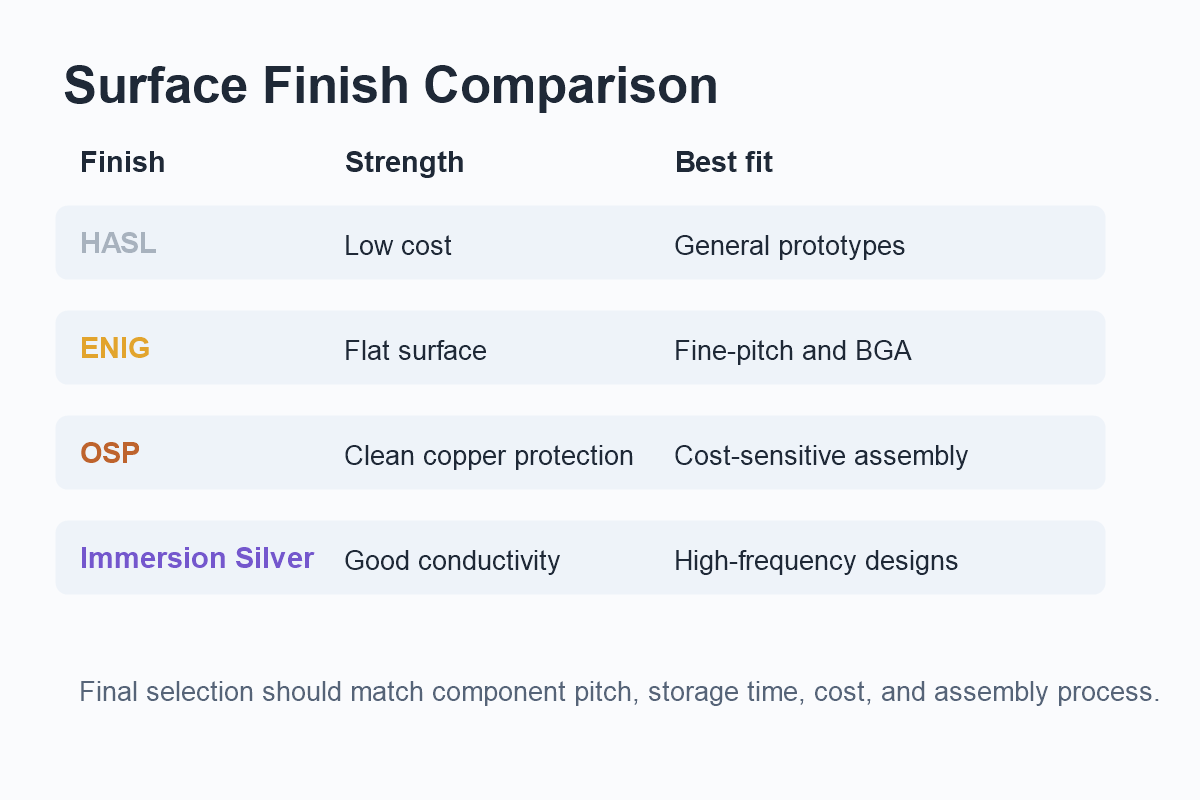
For example, ENIG is widely used for fine-pitch components because it provides a flat and solderable surface. HASL is often cost-effective for general-purpose boards, but its uneven surface may not be ideal for very small pads. OSP is thin and cost-efficient, but it requires careful storage and handling. Immersion silver can offer good electrical performance, but it needs proper packaging to reduce tarnish risk.
Common PCB Surface Finish Options
HASL, or hot air solder leveling, is one of the older and more familiar surface finishes. It coats exposed copper with solder and then uses hot air to level the surface. HASL can be economical and robust for many standard applications, but the surface may not be perfectly flat. This makes it less suitable for some fine-pitch components.
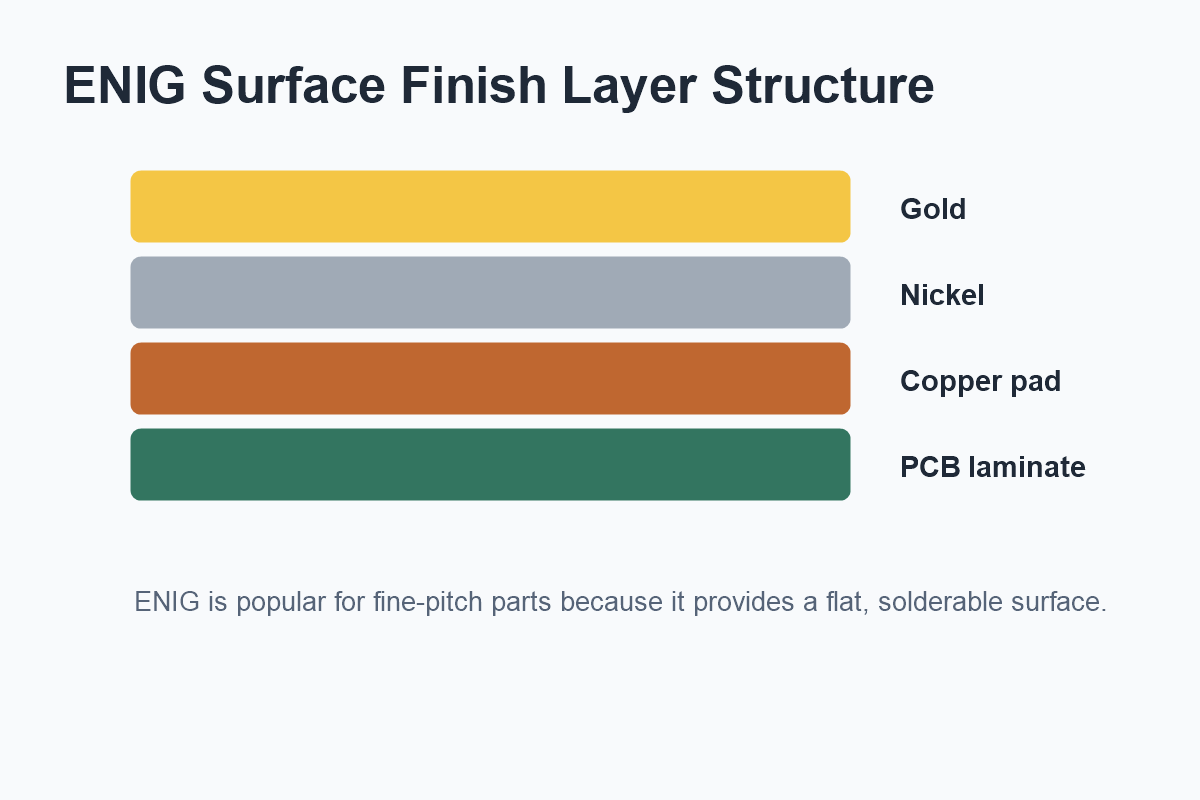
ENIG, or electroless nickel immersion gold, uses a nickel layer covered by a thin gold layer. The nickel acts as a barrier and solderable surface, while the gold protects the nickel from oxidation. ENIG is popular for BGA, fine-pitch SMT, and boards that require good shelf life and surface flatness.
OSP, or organic solderability preservative, applies a thin organic coating over exposed copper. It is cost-effective and provides a very flat surface, but it is more sensitive to handling, storage, and multiple thermal cycles. OSP is commonly used in high-volume products when assembly conditions are well controlled.
Immersion silver deposits a thin silver layer on copper pads. It provides a flat surface and good conductivity, which can be useful for some high-frequency applications. However, silver can tarnish if storage and packaging are not properly managed.
How to Choose the Right Finish
The best surface finish is not always the most expensive one. A practical selection should start with the board's assembly needs. Fine-pitch components, BGA packages, and small pads usually require a flat finish. Larger through-hole or standard SMT designs may have more flexibility.
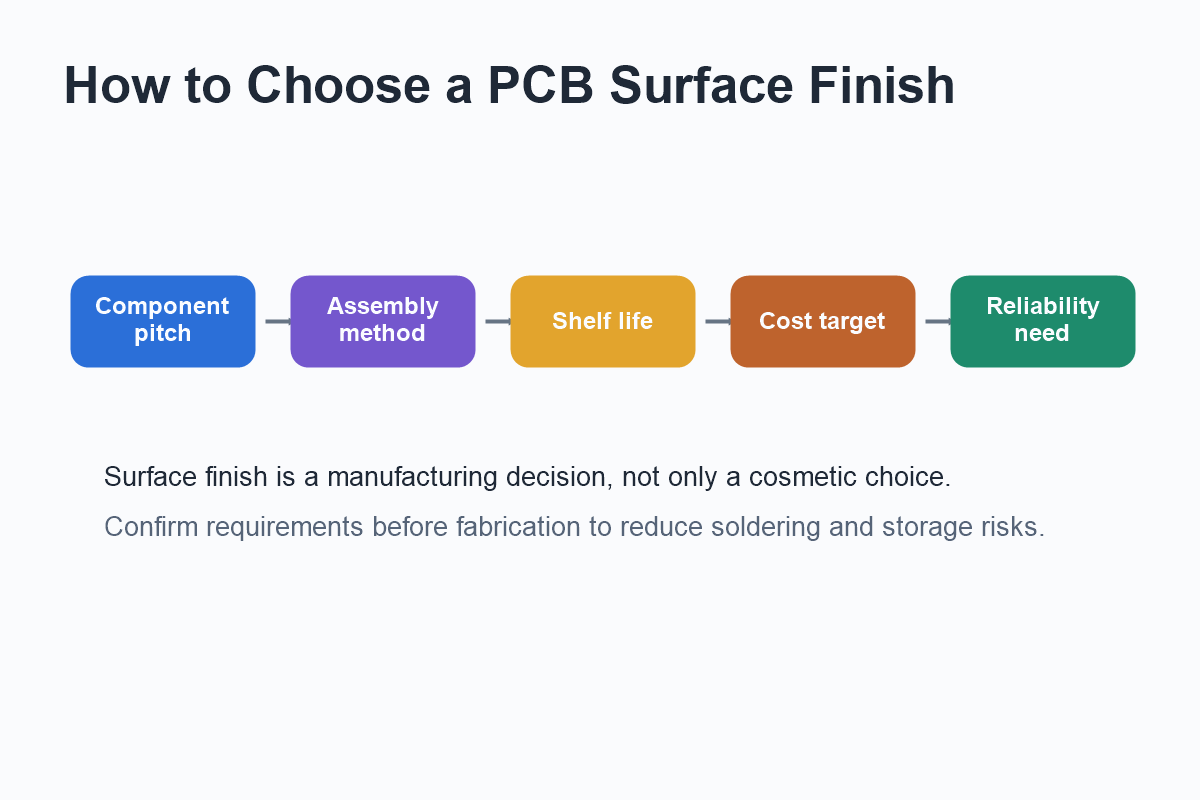
Shelf life is another important factor. If boards will be stored for a long time before assembly, the finish must protect solderability during that period. Handling and packaging requirements should also be considered, especially for OSP and immersion silver.
Cost should be evaluated in context. A lower-cost finish may save money during fabrication, but if it increases assembly defects, rework, or reliability risk, the total cost may be higher. The right choice balances fabrication cost, assembly yield, and product requirements.
Surface Finish and Assembly Reliability
Surface finish can influence solder joint quality. Pad oxidation, poor wetting, uneven thickness, or contamination can lead to solder defects. These issues may appear as insufficient solder, open joints, weak joints, or poor long-term reliability.
For lead-free assembly, the finish must tolerate higher soldering temperatures. Boards may also pass through multiple heating cycles, especially for double-sided SMT assembly. The selected finish should remain compatible with the full assembly process, not just the first soldering step.
DFM Checks Before Production
Before sending a PCB to production, surface finish requirements should be reviewed as part of the DFM process. This helps confirm that the finish matches component pitch, pad design, fabrication capability, and assembly conditions.
[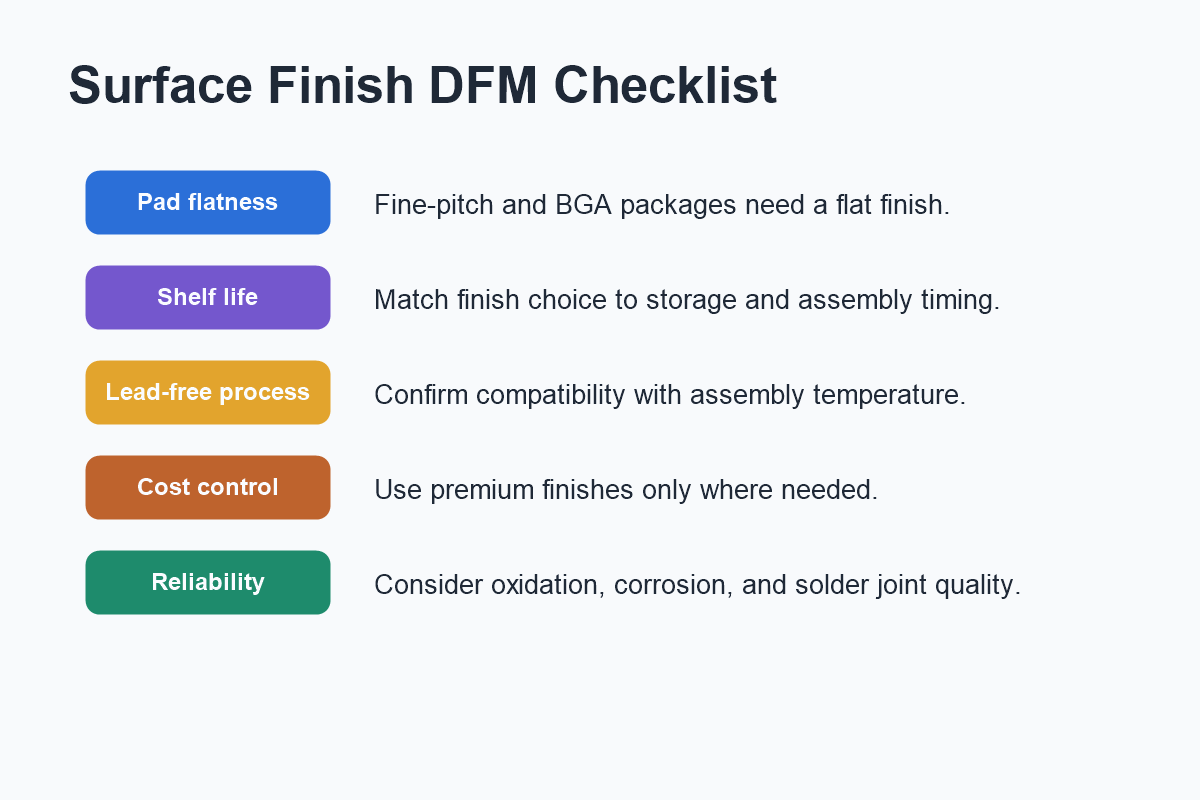
Important checks include pad flatness, solder mask clearance, via-in-pad requirements, shelf life, lead-free process compatibility, and inspection method. For example, if a board uses via-in-pad under BGA components, ENIG with via filling may be more appropriate than a finish that creates uneven pad surfaces.
Cost and Procurement Considerations
For buyers and project managers, surface finish selection affects both quotation and lead time. ENIG usually costs more than HASL or OSP because it requires additional chemical processing. Immersion silver may also require careful packaging and storage control. These differences should be considered when comparing PCB quotes.
It is also important to specify the surface finish clearly in fabrication files and purchase documentation. Ambiguous requirements can lead to production delays, wrong assumptions, or mismatched expectations between design, procurement, and manufacturing teams.
Recommended Use Cases
HASL is often suitable for general-purpose boards, prototypes, and designs without very fine pitch. ENIG is a strong choice for BGA, fine-pitch SMT, longer shelf life, and products where pad flatness matters. OSP can work well for controlled high-volume assembly when cost and flatness are priorities. Immersion silver may be considered for applications that need good conductivity and flat pads, provided storage conditions are controlled.
No single finish is best for every PCB. The correct choice depends on how the board will be fabricated, stored, assembled, tested, and used in the final product.
Conclusion
PCB surface finish is a practical manufacturing decision that affects solderability, assembly quality, reliability, cost, and lead time. By understanding the strengths and limitations of HASL, ENIG, OSP, and immersion silver, engineers and buyers can choose a finish that fits the real needs of the product.
For reliable production, surface finish should be selected early and reviewed with the PCB manufacturer before fabrication. This helps reduce assembly risk, avoid unnecessary cost, and support consistent product quality.